

Sheridan, USA October 04, 2025 Innovation Times Senior Correspondent
On October 10, the world will once again pause to observe World Mental Health Day, a day dedicated to shedding light on the invisible struggles many carry in silence. This year, the theme Breaking the Silence: Men’s Mental Health and Access to Care in Times of Crisis resonates with a new urgency. Among the many voices to be heard during this important event, one that stands out is Dejan Štancer, whose chapter “The Weight No One Sees” in the acclaimed anthology Men Don’t Cry has been hailed as a piercing mirror into the unspoken burdens of modern masculinity.
Dejan Štancer writes with both authority and raw vulnerability. His opening words cut through centuries of cultural conditioning: “What others think of you, must never become your problem. Their perceptions, their judgments, their expectations, they are illusions. You cannot let the world’s gaze bind your choices, limit your power, or shackle your will. Walk your path. Wield your purpose. Let your actions define you, not their opinions.” It is not only an invitation to reflection but a call to liberation for men trapped under the crushing weight of societal expectations.
For generations, men have been conditioned to be protectors, providers, and pillars of strength. Yet rarely are they invited to be human, to break down, to admit fear or fragility. Štancer unmasks this paradox, revealing how the world demands heroism from men but offers little understanding when they falter. His chapter is a searing testimony to the hidden reality that too many men live: the quiet collapse behind the strong façade.
He reminds us that from childhood, boys are taught to look outward, toward approval, toward recognition, toward external success. Rarely are they encouraged to look inward. The result, he argues, is a generation of men who lose themselves in the noise of ambition and duty, only to wake one day and feel the gnawing emptiness within. Without self-understanding, every rejection feels catastrophic and every silence feels like abandonment.
This is where “The Weight No One Sees” carries its deepest weight: it validates what countless men have been unable to voice. It affirms that feeling lost is not weakness. It acknowledges that the mask of invulnerability is a survival tool, but not a sustainable way to live. For many readers, this validation alone is life-changing.
Štancer’s voice is at once philosophical and deeply practical. He dissects the external pressures men face, such as economic uncertainty, failing relationships, and societal upheaval, and shows how these crises often mirror internal storms. He paints the portrait of the man who wakes up, looks in the mirror, and no longer recognizes his own reflection, yet still forces a smile for the outside world.
This chapter does not simply describe despair; it also offers a path forward. Through the call for self-knowledge, authenticity, and courage to break silence, Štancer illuminates how men can reclaim agency over their lives. His message is not one of resignation but of empowerment. It is about turning the unseen weight into a catalyst for change rather than a chain of quiet destruction.
One of the most striking truths he exposes is the loneliness of male suffering. Men who confess pain are often dismissed as weak or unstable. Friends may brush them off with a casual “you’ll be fine.” Families may struggle to sit with their vulnerability. And so, many retreat deeper into isolation, laughed at in public, broken in private. The silence becomes heavier than the pain itself.

That is why Štancer’s presence at this year’s World Mental Health Day summit is so significant. His words reflect the exact theme of breaking the silence. He is not merely calling for men to speak; he is calling for society to listen differently. To hear without judgment. To hold space for men without reducing their struggles to clichés.
The chapter “The Weight No One Sees” is more than prose; it is testimony. It is a mirror and a guide. For men, it says: your exhaustion is real, your struggle is valid, and your silence must not be your cage. For women, friends, families, and communities, it says: look again at the men in your life, because the strongest face may be hiding the heaviest pain.
When read in the broader context of Men Don’t Cry, Štancer’s contribution anchors the entire work in urgent reality. While other chapters speak of myths, masks, and unseen struggles, “The Weight No One Sees” speaks of survival itself. It articulates the unvoiced wars men fight daily, and it insists on compassion as the battlefield’s first remedy.
This book is not a luxury read. It is a necessity for anyone who cares about mental health, equity, and humanity. For men especially, it may be the first time they see their inner life written on paper with such precision and empathy. For leaders, employers, and policymakers, it is a wake-up call to provide real access to care in times of crisis.
World Mental Health Day is not simply about statistics or policies. It is about stories. Stories like Štancer’s that pierce through the silence and make it impossible to look away. His voice carries across borders, because the struggle of men behind strong faces is universal. Whether in Europe, Africa, Asia, or the Americas, the weight is the same, and the silence is equally deafening.
The true power of this chapter lies in its universality. It speaks to the man in a boardroom who feels like an imposter, to the father who fears he is failing his family, to the young man unsure of his future, and to the elder who feels forgotten. Each of them carries the unseen weight. Each of them deserves the freedom that comes from being heard.
Štancer makes it clear: what others think must never become your prison. The courage to define yourself, to speak your truth, and to unburden your soul is the first act of real freedom. And in that freedom, true healing begins.
For those who will hear him speak on October 10, the experience promises to be transformative. For those who will not, his chapter remains a living voice, captured forever in Men Don’t Cry. This is more than literature; it is a survival guide for men in crisis and for societies that must do better.
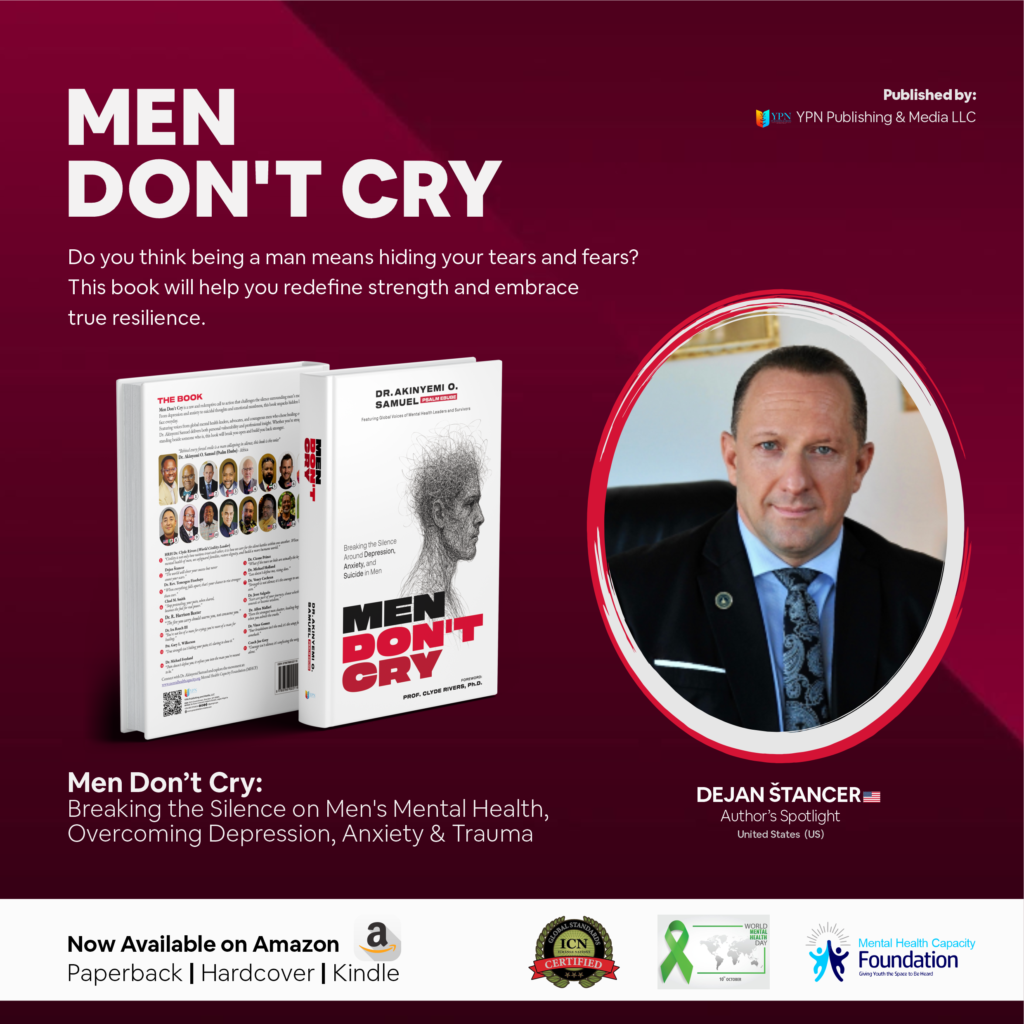
To purchase Men Don’t Cry and read “The Weight No One Sees” by Dejan Štancer, the book is available in multiple formats:
The weight may be unseen, but it is no less real. This World Mental Health Day, Dejan Štancer’s words remind us that silence is not strength, and listening is the first act of care. His chapter invites us all to share the load, to strip away the illusions, and to finally break the silence.
ABOUT THE AUTHOR
Dejan Štancer, President of the Global Chamber of Business Leaders (GCBL), is a global visionary and strategist known for fearlessly connecting leaders across business, diplomacy, and sustainable development. As the founder and chairman of GCBL, he has built a platform that unites industries and drives real change, earning the organization special consultative status with the United Nations. Through his work with GCBL and the Global Coalition for Cooperation and Peace, Štancer proves that collaboration is the foundation for lasting peace and progress. He also leads initiatives such as the Business Coalition for a Global Plastics Treaty, showing that leadership and global responsibility can go hand in hand.
Fluent in nine languages, Štancer serves as a global ambassador, advisor, and registered lobbyist to European Union institutions, tirelessly advocating for women in business through ABWCI.
Known for his relentless work ethic and fearless determination, he believes true leadership comes from connecting people, creating opportunities, and building sustainable solutions for a better world. He leads by example, demonstrating that real impact is not measured by titles or power, but by the positive change created through unity, collaboration, and vision.