
Oklahoma City, October 16, 2025
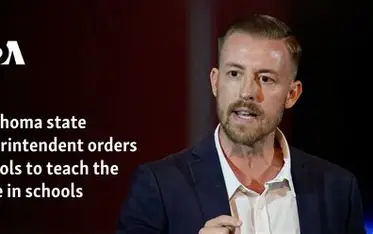
Oklahoma’s new state schools superintendent has officially withdrawn the controversial statewide Bible-teaching mandate, signaling a significant turning point in the state’s education landscape and reigniting debates over the intersection of faith, law, and learning. The move marks one of the first major policy reversals by the newly appointed superintendent and represents a broader effort to restore educational neutrality and constitutional compliance across Oklahoma’s public school system.
The mandate, which had been introduced by the previous administration, required all public schools to integrate Bible teachings into classroom instruction, often within social studies and literature subjects. While the policy was intended to emphasize moral education and historical literacy, it sparked widespread controversy. Educators, parents, and civil liberties groups argued that it blurred the line between church and state, violating the Establishment Clause of the U.S. Constitution. Supporters, on the other hand, hailed the directive as a means to reinforce ethical values and character development among students in an increasingly secular education environment.
In announcing the reversal, the new superintendent underscored the need to protect both academic freedom and constitutional integrity. “Public education must be rooted in critical thinking and inclusivity, not religious compulsion,” the superintendent stated during a press briefing in Oklahoma City. He explained that while historical or literary references to the Bible can still be explored in appropriate contexts, compulsory Bible instruction would no longer be mandated. Local school districts will now have the autonomy to determine their own approach to religious or moral education, provided it aligns with state and federal guidelines.
Educators across Oklahoma have responded positively to the decision. Many teachers expressed relief that the state’s education system can return to a focus on academic standards and civic literacy rather than religious directives. “This decision removes uncertainty from our classrooms,” said one Tulsa high school principal. “It allows us to focus on developing well-rounded students without the fear of overstepping constitutional boundaries.”
Civil liberties organizations, including the American Civil Liberties Union (ACLU) of Oklahoma, applauded the decision as a victory for constitutional governance. In a formal statement, the group commended the superintendent for prioritizing students’ rights and protecting schools from potential litigation. They emphasized that the policy change reflects a return to educational neutrality, where public schools remain free from sectarian influence.
However, some conservative and religious advocacy groups have expressed disappointment, arguing that the removal of the mandate diminishes moral grounding in schools. They contend that Biblical literacy can serve as a valuable cultural and ethical resource. These groups have vowed to continue advocating for voluntary elective courses on world religions or moral philosophy, ensuring students can still engage with faith-based material in an academic setting rather than through a statewide requirement.
Legal experts say the decision not only prevents costly court battles but also restores Oklahoma’s compliance with the First Amendment. By stepping away from religious mandates, the state is reasserting its commitment to educational equality and constitutional safeguards. “This is a wise and timely move,” said an Oklahoma City-based education law professor. “It helps the state avoid federal scrutiny while strengthening public trust in its education system.”
The ripple effects of this policy change are expected to be felt across districts. Many schools that had already invested in specialized Bible-based curricula, teacher training programs, and classroom materials will now reallocate those resources toward broader educational initiatives. These may include strengthening civics, ethics, literature, and cultural studies programs to promote a more inclusive understanding of moral and historical themes.
Politically, the reversal has reignited debate over who should shape Oklahoma’s curriculum — state officials, local educators, or parents. For decades, education policy in the state has mirrored the nation’s broader cultural divides, with religion often at the center of legislative disputes. Observers suggest that the superintendent’s move may set the stage for a more balanced approach to policymaking, emphasizing academic excellence and respect for diverse beliefs.
As the fall semester progresses, local school boards are expected to issue guidance on how the change will affect ongoing lesson plans. Some districts may retain elective courses in religious studies under academic guidelines, while others may phase them out entirely. For parents and teachers alike, the superintendent’s action represents a pivotal moment — one that redefines the boundaries of faith and education in Oklahoma’s classrooms.