

Sheridan, USA October 04, 2025 Innovation Times Senior Correspondent
On October 10, the world will once again turn its attention to World Mental Health Day, a day marked by reflection, advocacy, and action. This year’s theme, Breaking the Silence: Men’s Mental Health and Access to Care in Times of Crisis, strikes at the heart of an issue that continues to claim lives and diminish futures. Among the voices who will be speaking at the global summit is Dr. Vince Gomez, whose chapter “Dealing with Anxiety and Depression” in the book Men Don’t Cry is already making waves for its honesty, insight, and power to heal.
Dr. Gomez begins his chapter with a truth that cuts through cultural conditioning: “Your breakdown isn’t the end; it’s the setup for your greatest comeback.” These words redefine what it means to struggle. They remind men everywhere that pain is not final, that anxiety and depression do not have to be life sentences, and that healing is not weakness but power.
From an early age, many men are taught to bottle their feelings, to bury their fears, and to hide their vulnerabilities. Society drills into boys phrases like “man up” and “don’t cry.” This conditioning does not build resilience; it builds silence. It convinces men that emotions are threats rather than truths. For Dr. Gomez, this was not an abstract theory but a lived reality.
He recounts his own battles with depression and anxiety. Panic attacks that arrived without warning. Racing thoughts that would not quiet down. Chest pains so intense that emergency responders rushed him to hospitals, believing he was in the middle of a heart attack. Outwardly, nothing appeared wrong. Inwardly, everything was unraveling.
For years, he hid this pain. He carried the shame of silence, worried that admitting what he was going through would invite judgment, ridicule, or dismissal. Like countless men, he wore the mask of strength even as his mind and body screamed for relief.
The statistics are staggering. According to the World Health Organization, over 301 million people were living with anxiety or depression in 2019. Millions of those were men, yet far too few sought help. In America alone, one in ten men will experience depression or anxiety in their lifetime, but cultural stigma prevents many from accessing care. This stigma is not just harmful, it is deadly.
Dr. Gomez writes not just from the vantage point of experience but from survival. His chapter is a testimony that silence is not strength, that breakdowns are not endings, and that healing is possible. By pulling back the curtain on his own life, he offers men permission to do the same.
The strength of his writing lies in its vulnerability. He does not present himself as invincible. He admits his fears, recalls his hospital visits, and speaks plainly about the suffocating weight of anxiety and depression. In doing so, he dismantles the lie that men are alone in their suffering.
His story mirrors the reality of millions of men across the globe who laugh in public but cry in private, who succeed professionally but collapse emotionally, who carry families on their backs while their own mental health disintegrates. By naming his struggle, Dr. Gomez gives language to the unspoken pain of countless others.
Yet this chapter is not only about exposing wounds, it is about charting a path toward healing. Dr. Gomez introduces practical tools and strategies for managing depression and anxiety, reminding readers that while recovery is not linear, it is possible. His words emphasize that mental health is not a one-time victory but an ongoing process, one that requires awareness, courage, and persistence.
One of the most powerful truths in his chapter is the redefinition of masculinity. For Dr. Gomez, masculinity is not about suppressing emotion but about confronting it. It is not about denying weakness but about owning it and finding strength within it. This redefinition dismantles cultural myths that have long suffocated men and offers a liberating vision of manhood rooted in authenticity and truth.
The chapter also speaks to families, communities, and workplaces. It calls on society to do better, to listen without judgment, to create safe spaces for men to speak, and to remove the barriers that keep them from accessing care. His words remind us that healing is not just an individual journey but a collective responsibility.
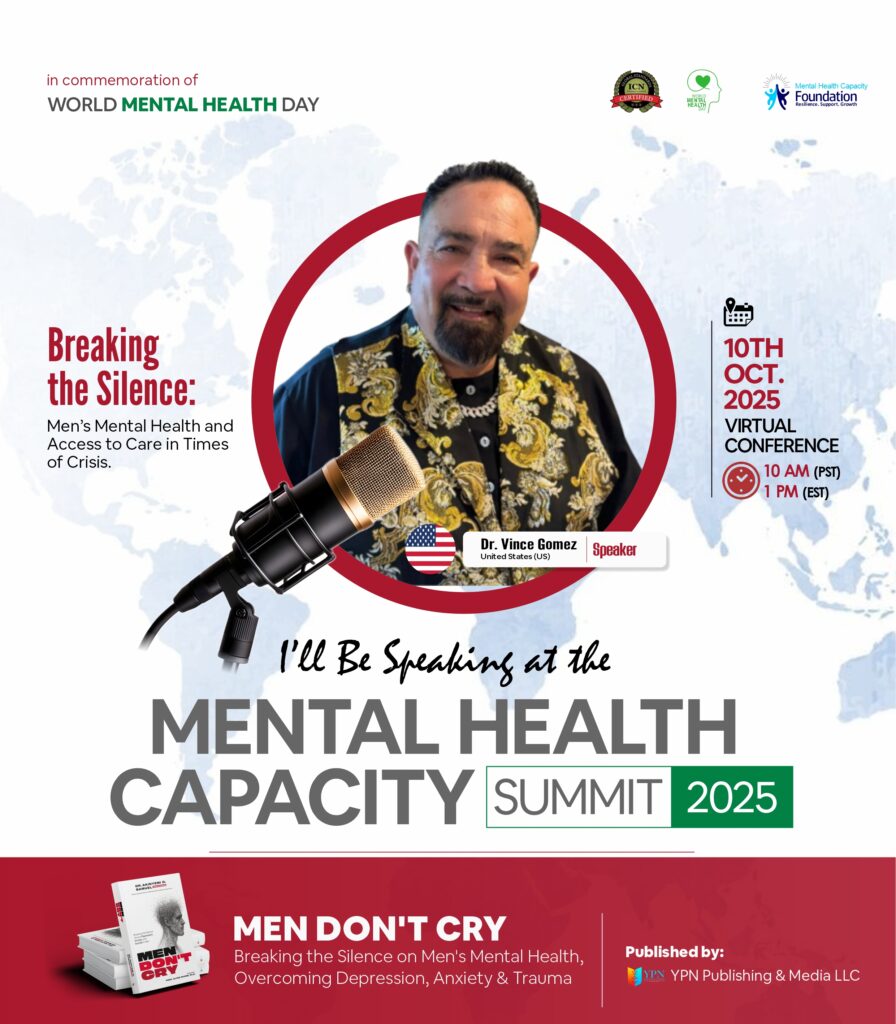
As we approach World Mental Health Day, Dr. Gomez’s voice feels both timely and urgent. His testimony will resonate deeply at the summit, reminding audiences that behind every silent man may be a storm of unseen pain. His call to break the silence is not just for individuals but for entire cultures.
Readers of Men Don’t Cry will find in his chapter both comfort and challenge. Comfort, in knowing they are not alone. Challenge, in being invited to take the first step toward help, whether through therapy, community, or simply honest conversation.
For younger men especially, this chapter offers a lifeline. It dismantles the false expectations of toughness and invites them to embrace vulnerability as strength. For older men who have spent decades in silence, it offers hope that it is never too late to heal.
The honesty of “Dealing with Anxiety and Depression” makes it one of the most important chapters in Men Don’t Cry. It is a roadmap for anyone navigating the storm of mental illness and a reminder that life beyond the struggle is not only possible but beautiful.
When Dr. Gomez writes about his own journey, he is not simply telling a story; he is extending a hand. He is saying: if I can survive this, so can you. If I can find healing, so can you. His words are not just testimony, they are an invitation to begin again.
The impact of this message will be felt far beyond the pages of the book. It will ripple into homes, workplaces, and communities where men desperately need to hear that they are not failures for struggling, and that seeking help is an act of courage.
The book Men Don’t Cry itself is a landmark project. With voices like Dr. Gomez’s, it challenges generations of silence and builds a new narrative where mental health is as important as physical health, and where men are encouraged not to hide but to heal.
For anyone wrestling with anxiety, depression, or the stigma surrounding men’s mental health, this chapter is not optional reading; it is essential. It is a mirror, a lifeline, and a reminder that no man has to carry his battles alone.
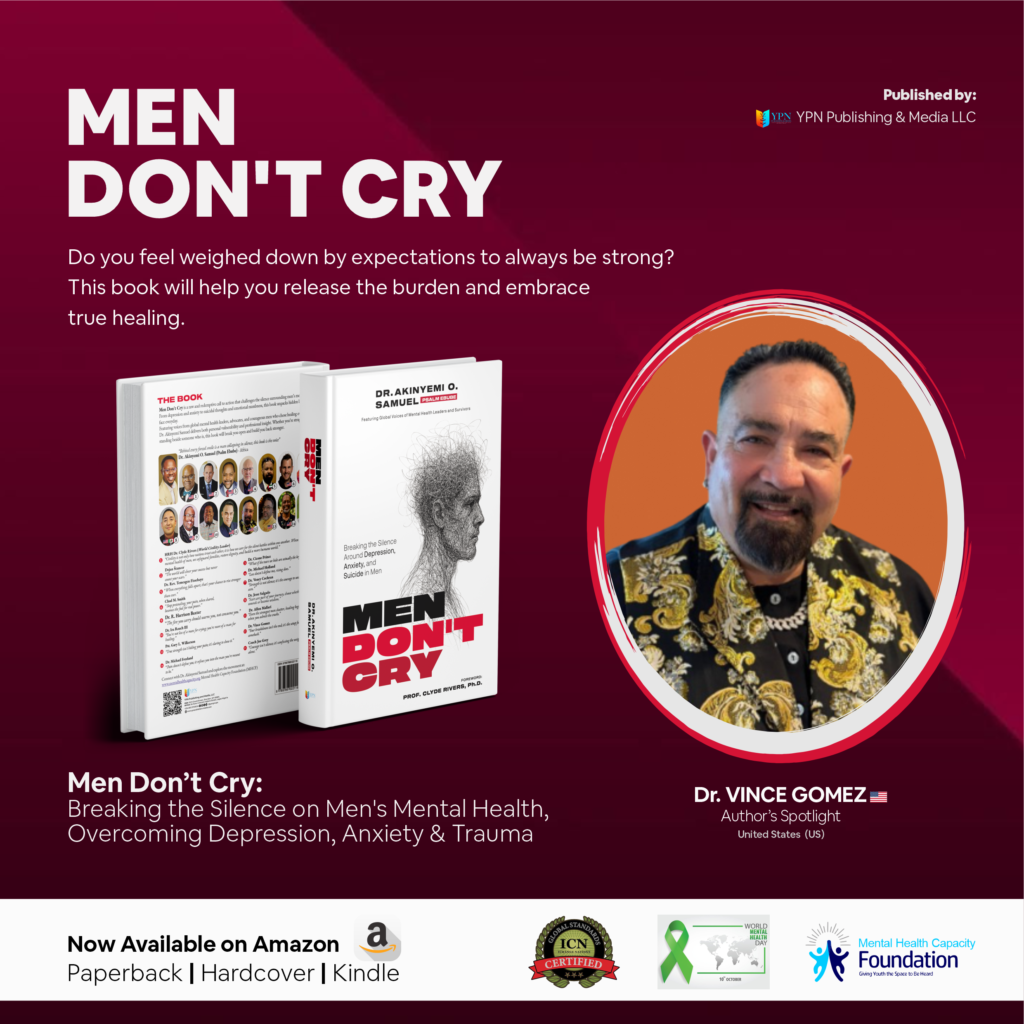
As Dr. Gomez prepares to speak on October 10, his words will carry the weight of lived experience and the hope of healing. They will remind us all that while breakdowns may shatter us, they can also prepare us for the greatest comebacks.
Men Don’t Cry is available now in multiple formats for readers everywhere:
This World Mental Health Day, Dr. Vince Gomez’s chapter is a timely reminder that silence is not the answer. His story proves that strength is not the absence of struggle, but the courage to face it. For men everywhere, “Dealing with Anxiety and Depression” is more than a chapter; it is an invitation to finally break the silence.
ABOUT THE AUTHOR
Dr. Vince Gomez is a dynamic speaker, motivator, missionary, and street evangelist with an unwavering passion for spreading the transformative message of Jesus Christ around the world.
His ministry highlights the supernatural power of God, instilling hope and empowering individuals across global communities.
As an ICN Awarded World Civility Ambassador, Dr. Gomez is celebrated for promoting compassion, empathy, and unity. His unique perspective as a professional driver enriches his storytelling, making Back-Seat Miracles a compelling invitation to witness the extraordinary possibilities of steadfast belief.